Three Seconds at the Christmas Stall: A 2026 Branding Checklist for UK Market Traders
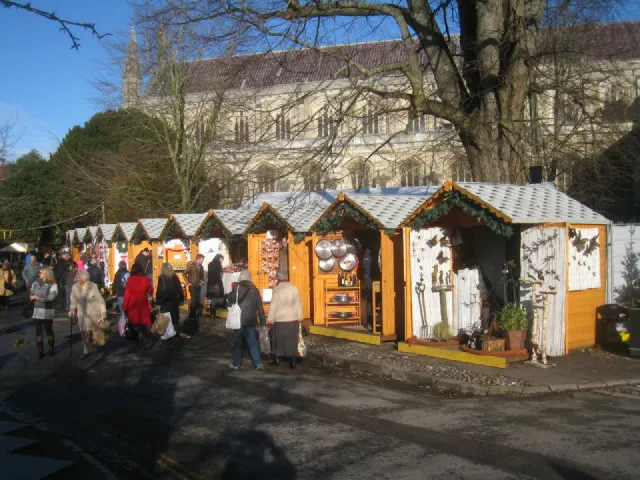
Photo: Sandy B , CC BY-SA 2.0, via Wikimedia Commons
You have about three seconds. That's not a guess — it's roughly how long a person shuffling past a chalet in a knitted hat will give your stall before their eyes move to the mulled wine queue behind you.
Three seconds to answer four silent questions: What is this? How much is it? Is it for me? Can I be bothered?
Most stalls answer none of them, then wonder why the footfall didn't convert. With markets in full swing across the country — from the German Market in Birmingham to Manchester's sprawl of wooden huts, York's St Nicholas Fair and the smaller church-hall fairs that quietly do the best trade — here's a checklist worth running before your next pitch.
Signage: one headline, one price anchor, no essays
Your sign has one job: stop the walk. Not explain your sourcing policy, not list twelve products, not tell your life story in a handwritten font nobody over forty can read.
Work in a hierarchy.
- Top line, biggest: what you sell, in plain words. 'Hand-poured soy candles.' Not 'Artisan olfactory experiences'.
- Second line: one differentiator. 'Made in Sheffield. Burn for 45 hours.'
- Third line: a price anchor. 'From £12.'
If your sign is on the back wall of the stall, it's invisible. Put the headline high and facing the flow of people, and if you can afford it, duplicate it on the side so browsers approaching from either direction get the same hit.
Dark text on a light board always wins at dusk. Resist the chalkboard aesthetic if the light is fading and your handwriting is not your strongest skill.
One offer, not a table of options
Christmas shoppers are decision-fatigued by the time they reach you. A stall with forty SKUs at forty prices reads as hard work.
Pick a hero. Put it front and centre, at eye level, with a small handwritten note explaining why people buy it. Everything else is supporting cast. If you sell gift sets, build two or three fixed bundles and price them clearly — bundles are the single easiest way to lift average spend at a market because they remove the choosing.
Prices you can read from a metre and a half
The question you will hear four hundred times this month is 'how much is that one?' Every time you answer it, you've lost the chance to talk about something more interesting.
Price every item. Big enough to read from the other side of the aisle. If something is £8, write £8 — not £8.00, and definitely not a code you have to look up. Card reader out, clearly visible, contactless symbol on the sign. Half your customers will assume you're cash-only unless you tell them otherwise.
QR codes: put them where hands already are
A QR code at the back of the stall is decoration. A QR code on the table, at the point where someone is already holding a product, is a conversion.
Print it at least 4cm square, test it on two phones in low light, and give it a reason: 'Scan for the rest of the range — 10% off your first order.' Add a line of text under the code telling people what happens next, because a bare code asks the shopper to trust a stranger's link in the cold.
Table presentation: height, depth, tidiness
Flat tables are where products go to be overlooked. Build layers — a crate, a box covered in plain fabric, a small step — so items sit at three heights. Depth matters too: keep the front edge clear enough for hands, cluster the bestsellers in the middle third, and let the back row be visual rather than shoppable.
Two practical things that separate a professional-looking stall from a car boot sale: a plain cloth to the floor, and somewhere hidden for your boxes, coats and flask. Nobody buys from a stall that looks like it's still being unpacked.
The one question that builds the list
You will talk to far more people than you sell to. That's normal and it's fine — as long as you capture some of them.
Skip 'can I interest you in signing up to my newsletter?' Nobody says yes to that. Instead, when someone pauses over a product, ask: 'Do you want me to let you know when I'm back at a market near here?'
It's specific, it's low-commitment, and it's genuinely useful — people who've just browsed your stall are often planning their next weekend out. Have a paper sign-up sheet with clear columns and a pen that works, plus a QR to your mailing list if you'd rather keep it digital. Ask for a first name and an email, nothing more. The GDPR bit belongs on the sheet in one plain sentence, and you should be able to say it out loud without sounding like a form.
The night-before checklist
- Headline sign printed, laminated, and big enough to read from six metres
- Every item priced, with a 'from £' anchor on the front board
- Two bundles built and named
- Card reader charged, plus a backup payment option
- QR tested on two phones, with a reason to scan
- Three heights on the table, cloth to the floor
- Storage hidden, flask hidden, bin bag hidden
- Sign-up sheet, two pens, and one question rehearsed
- One person designated to stand in front of the stall, not behind it
That last point matters more than any sign. If nobody from your team is out in the flow, chatting, handing over a tester or a mince pie, the stall is just furniture. Three seconds is not long — but it's enough to look like the stall that knows exactly what it is.